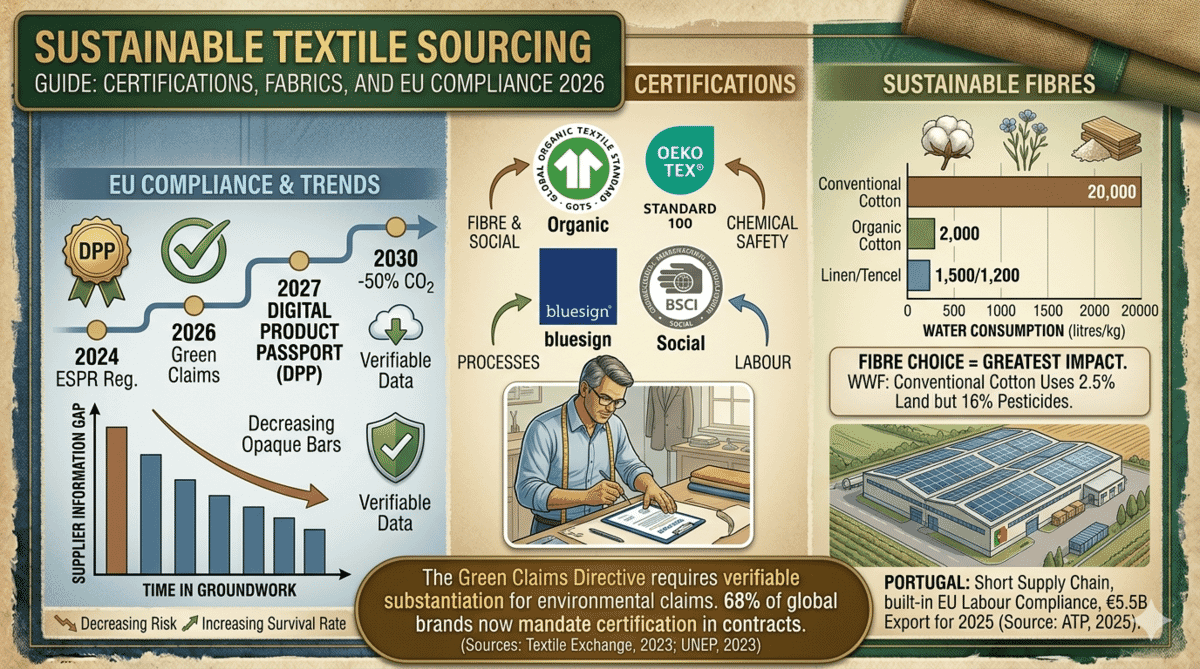
The textile industry has reached a tipping point. Cotton occupies roughly 2.5% of the world's agricultural land but accounts for about 16% of global insecticide use (WWF). Note the distinction: the widely quoted 16% figure is for insecticides specifically, not all pesticides, and industry bodies put the all-pesticide share far lower. These numbers explain why so many brands are searching for alternatives. The supply of "sustainable" fabrics is vast, confusing, and at times misleading.
What This Guide Covers
This guide analyses the main options available in 2027: organic cotton, recycled cotton, rPET polyester, regenerated nylon, linen, hemp, and Tencel. In each section you'll find concrete data, honest comparisons, EUR pricing from the Portuguese market, and verifiable sources. The goal isn't to sell a magic solution. It's to help you make informed, evidence-based decisions before you specify a fabric on your tech pack.
Heads up: We're Portugal Clothing Factory, a group of 80 documented Portuguese clothing factories. The pricing and MOQ ranges below come from quotes across Portuguese mills and factories between 2024 and 2026. EUR throughout, manufacturer-group lens.
Related: complete sustainable sourcing guide
Key Takeaways
- Organic cotton showed 91% lower blue water (irrigation) use in Textile Exchange's LCA, but the study compared irrigated conventional with rain-fed organic, so quote it precisely
- Recycled polyester (rPET) cuts production energy substantially versus virgin polyester, with published estimates spanning roughly 30 to 60%
- Directive (EU) 2024/825, applicable since 27 September 2026, bans generic environmental claims and sustainability labels not based on a certification scheme. The separate Green Claims Directive was withdrawn and never adopted
- Sustainable fabric prices typically run 15-40% higher than conventional equivalents
- GOTS, OEKO-TEX, GRS, and Bluesign are the four certifications worth knowing
- Portugal has a deep network of certified suppliers across the Ave Valley and Guimarães region
- Sustainable fabric MOQs run higher (200-500 metres typical) and lead times are 2-4 weeks longer than conventional
Try it free: Pressure-test your sustainable fabric cost with our garment cost calculator before specifying. 60 seconds, no email required.
What Makes a Fabric Truly Sustainable?
No fabric is 100% sustainable, but there are measurable criteria. Most large brands now require some form of sustainability certification from their suppliers, and the share has climbed steadily through Textile Exchange's annual materials reporting (Textile Exchange). The short answer: a sustainable fabric minimises environmental impact across the entire lifecycle, from raw material to end of use.
Citation Capsule: Most large brands now require sustainability certification from their suppliers, and the share keeps rising in Textile Exchange's annual materials reporting. A truly sustainable fabric is assessed by total lifecycle environmental impact, not just the origin of the fibre.
Core assessment criteria
Textile sustainability isn't just about the fibre. It involves four dimensions: water consumption, chemical use, carbon emissions, and circularity (recyclability or biodegradability). A fabric can be "organic" at the source and carbon-intensive in dyeing. The analysis must be holistic.
| Dimension | What it measures | Best-performing fibres |
|---|---|---|
| Water | Litres per kg of fibre | rPET, recycled cotton, hemp |
| Chemicals | Pesticides, dyes, finishes | Organic cotton, hemp, Tencel |
| Carbon | kg CO₂e per kg of fibre | Recycled cotton, hemp, linen |
| Circularity | Recyclable or biodegradable end-of-life | Recycled cotton, linen, hemp |
Source: see in-text citations in this section.
The role of certifications
Certifications act as third-party guarantees. GOTS, OEKO-TEX, Bluesign, and GRS verify different aspects of the value chain. None is perfect in isolation. A total absence of certification is, today, a clear red flag for professional buyers.
The rule that actually applies: Directive 2024/825
There is a widespread misunderstanding here worth clearing up, because it affects how you write your labels. The much-discussed Green Claims Directive was withdrawn: the Commission announced it would not proceed in June 2025 and the proposal was never adopted. What does apply is Directive (EU) 2024/825 on empowering consumers for the green transition, in force since 27 September 2026. It bans generic environmental claims such as "eco-friendly" or "climate neutral" where the excellent environmental performance cannot be demonstrated, and it bans sustainability labels that are not based on a certification scheme or established by a public authority. Penalties sit under the Unfair Commercial Practices Directive, where fines can reach 4% of turnover in the member states that set them that high. The practical effect on fabric specification is the same as the Green Claims Directive would have had, but the legal basis you cite must be the real one.
Organic Cotton vs Recycled Cotton: Which Should You Choose?
| Fibre | Water (L/kg) | CO₂ (kg CO₂e/kg) | Key certifications | Typical EUR/m (Portugal) | Cost premium vs conventional |
|---|---|---|---|---|---|
| Conventional cotton | 10,000 | 5.9 | Rarely certified | €4-€8 | Baseline |
| Organic cotton | 900 | 3.5 | GOTS, OCS | €6-€12 | +25-50% |
| Recycled cotton | 250 | 0.9 | GRS, RCS | €5-€10 | +15-35% |
| rPET polyester | 40 | 2.3 | GRS, RCS | €5-€11 | +15-30% |
| Tencel / Lyocell | 500 | 2.0 | FSC, EU Ecolabel | €8-€16 | +50-80% |
| Linen | 600 | 1.5 | European Flax, GOTS | €10-€22 | +60-120% |
| Hemp | 500 | 1.6 | GOTS, OCS | €9-€18 | +50-90% |
Sources: Textile Exchange (2022).
Sources: Textile Exchange 2022, WWF 2022, Lenzing AG 2023, PCF aggregated mill quotes 2024-2026.
The answer depends on the brand's priorities. Textile Exchange's life-cycle assessment measured 91% lower blue water consumption for organic cotton, alongside 46% lower global warming potential and 62% lower primary energy demand. The blue water figure needs care: the conventional cotton sampled was irrigated and the organic was largely rain-fed, so part of that gap reflects growing region rather than farming method. Recycled cotton diverts waste from landfill and reduces demand for virgin fibre. Both have merit, but they serve different objectives.
Citation Capsule: Textile Exchange's LCA measured 91% lower blue water consumption, 46% lower global warming potential and 62% lower primary energy demand for organic versus conventional cotton. The blue water gap partly reflects irrigated versus rain-fed growing regions, so the claim should be stated as blue water specifically. Recycled cotton redirects textile waste from landfill instead.
Advantages of organic cotton
Organic cotton eliminates synthetic pesticides and chemical fertilisers. GOTS certification guarantees traceability from field to finished product. For brands that communicate directly with end consumers, GOTS-certified organic cotton offers a clear and verifiable narrative. Demand has grown consistently over the past five years.
In our placement records, brands operating on certified organic cotton consistently achieve premium retail positioning above €60 for tees and €130 for hoodies. The cost premium amortises into the retail price comfortably.
Limitations of organic cotton
Global organic cotton production represents less than 1% of total cotton supply. This creates pressure on price and availability. "Organic" doesn't automatically mean "local" or "low carbon." If organic cotton travels thousands of kilometres for processing, transport footprint cancels out part of the benefits. Lead time on certified organic cotton in Portugal often runs 6 to 10 weeks for stock fabric and 12 to 18 weeks for custom-developed organic, vs 3 to 6 weeks for conventional.
When to choose recycled cotton
Recycled cotton makes sense when the brand is committed to circularity. It uses pre-consumer waste (factory offcuts) or post-consumer waste (used clothing). The resulting fibre is shorter, which can limit applications. For products like basic tees or home textiles, it works well. It requires no additional land, water, or pesticides.
In our placement records, the combination of 70% organic cotton and 30% recycled cotton offers the best balance between fibre quality and reduced environmental impact for jersey and sweatshirt programs. Pure 100% recycled cotton works for heavyweight knit accessories but tends to pill on lighter-weight tees.
How Do Recycled Synthetic Fabrics Compare?
Recycled polyester (rPET) takes substantially less energy to produce than virgin polyester, with published estimates spanning roughly 30 to 60% depending on the system boundary and the recycling route (European Environment Agency). This makes it a relevant option for sportswear, outdoor, and casual fashion brands. Regenerated nylon, such as ECONYL, follows similar logic by transforming fishing nets and industrial waste into new fibre.
Citation Capsule: Recycled rPET polyester consumes substantially less production energy than virgin polyester, with published estimates in the 30 to 60% range depending on system boundary (EEA). Regenerated ECONYL nylon transforms marine and industrial waste into high-quality fibre, reducing dependence on virgin petroleum.
How rPET polyester works
rPET comes primarily from PET bottles that are shredded and extruded into yarn. Each recycled bottle avoids the extraction of virgin petroleum. The process requires energy, but significantly less than conventional production. It's a pragmatic solution, not a perfect one. It reduces two problems simultaneously: plastic in landfill and dependence on fossil fuels.
For activewear and performance brands, rPET is now the default rather than the exception. Portuguese mills specialising in performance jersey routinely run rPET programmes at 65 to 100% recycled content with GRS certification. Ask for the GRS scope certificate and a transaction certificate tied to your specific batch.
Regenerated nylon: the ECONYL case
Aquafil, an Italian company, produces ECONYL from abandoned fishing nets and nylon waste. The material can be recycled infinitely without loss of quality. For swimwear and activewear brands, it's one of the most compelling options on the market. ECONYL pricing in Portugal runs €8 to €16 per metre depending on weight and finish, roughly 30 to 60% above conventional nylon.
Limitations of recycled synthetics
Recycled doesn't mean microplastic-free. Each wash of synthetic clothing releases microscopic fibres into the water system. This is the problem recycled synthetics haven't yet solved. Washing machine filters help but don't eliminate the issue.
It's worth being honest about this limitation. Recycled synthetics solve the plastic crisis but perpetuate the microplastic one. Brands with a long-term view should communicate both sides of this to consumers. Under Directive 2024/825, a claim that highlights recycled content while staying silent on microplastic shedding is exactly the kind of selective environmental claim that draws scrutiny.
Which Alternative Natural Fibres Work Best?
Western Europe, and France in particular, dominates world production of long-fibre flax for quality linen (CELC). Linen, hemp, and Tencel (lyocell) represent three alternatives with solid environmental profiles. Each has distinct strengths: hemp's natural durability, Tencel's softness, linen's breathability and European supply chain.
Citation Capsule: Western Europe dominates world production of the long-fibre flax used for quality linen (CELC), which puts the supply chain close to Portuguese mills. Tencel/Lyocell, made by Lenzing AG, recovers more than 99% of its solvent in a closed loop, making it one of the most process-efficient cellulosic fibres available.
European linen: tradition with low impact
Linen requires no irrigation in most European climates. It grows well in poor soils. It's biodegradable. Proximity of production to Europe significantly reduces transport footprint for brands sourcing through Portugal. Linen's texture is increasingly valued in premium summer collections.
Pricing in Portugal runs €10 to €22 per metre for European Flax-certified linen depending on weight (140 to 280 GSM range). MOQs typically 200 to 500 metres at certified mills. Lead times 6 to 10 weeks for stock weights.
Hemp: the underrated fibre
Hemp grows rapidly, requires no pesticides, and improves soil quality. European regulation has relaxed in recent years, making industrial cultivation easier. The fibre is extremely durable, ideal for denim and workwear. Traditional processing was harsh and produced a stiff fabric. Modern softening techniques have changed that completely.
Hemp blends (typically hemp + organic cotton, 30/70 or 50/50) are increasingly available in Portugal at €9 to €18 per metre. Pure hemp remains scarcer and more expensive.
Tencel/Lyocell: closed-loop production
Tencel, a Lenzing AG trademark, is produced from wood pulp in a closed-loop system. The process reuses 99% of the solvents used. The resulting fabric is soft, breathable, and biodegradable. For shirts, underwear and knitwear, it's one of the best options available.
We've observed a significant increase in Portuguese brands integrating Tencel into spring-summer collections. The most cited reason isn't marketing, but the hand-feel and drape of the fabric, which designers consider superior to conventional cotton. Tencel pricing in Portugal: €8 to €16 per metre for stock weights, MOQs typically 300 to 500 metres at certified mills.
Why Does Lifecycle Thinking Matter Beyond Fibre Choice?
The fibre is one input. Garment sustainability is the sum of choices across the lifecycle: fibre, spinning, weaving or knitting, dyeing, finishing, packaging, transport, use phase, and end of life. A "sustainable" fibre processed conventionally still produces a high-impact garment.
| Lifecycle stage | Typical share of total impact | High-leverage decisions |
|---|---|---|
| Fibre production | 25-40% | Organic, recycled, regenerated cellulose |
| Yarn and fabric formation | 10-15% | Energy source, spinning efficiency |
| Dyeing and finishing | 20-30% | Bluesign, dope-dye, low-water reactive |
| Cut-and-sew | 5-10% | Cutting waste, energy efficiency |
| Packaging and transport | 5-10% | Sea vs air, recycled packaging |
| Use phase | 10-30% | Wash temperature, drying method |
| End of life | 0-5% | Designed-for-recyclability, take-back |
Source: indicative ranges compiled from published textile life-cycle literature. Shares vary substantially by fibre, product and dyeing route, so treat them as an order-of-magnitude guide rather than fixed values.
The implication: pairing a sustainable fibre with conventional dyeing captures only part of the available environmental gain. Pairing it with low-impact dyeing, recycled packaging, and end-of-life design captures most of it.
For brands marketing sustainability under Directive 2024/825, lifecycle data is the strongest defence against a greenwashing challenge. Generic "sustainable" claims fail; lifecycle-attributed claims (with specific stages quantified) survive scrutiny.
What's the Dye-Stage Problem?
Dyeing is one of the most resource-intensive stages in textile production. Textile dyeing and treatment is commonly estimated to account for around 17 to 20% of industrial water pollution, a figure usually traced to World Bank analysis. A sustainable fibre processed in a conventional dye house keeps the fibre-stage savings but sacrifices the overall lifecycle gain.
Low-impact dye options in Portugal
| Process | Water impact vs conventional | Energy impact | Cost premium | Portuguese availability |
|---|---|---|---|---|
| Conventional reactive dye | Baseline | Baseline | Baseline | Universal |
| Bluesign-certified dyeing | -10 to -20% | -10 to -15% | +5-10% | Several certified mills |
| Low-water reactive | -30 to -40% | Comparable | +10-15% | Growing |
| Dope-dyed (synthetics) | -90% | -50% | +5-10% | Specialist mills |
| Natural dye (small-batch) | Variable | Higher | +30-80% | Niche factories |
| Wastewater-treated conventional | Same dye, treated effluent | Comparable | +10-20% | Standard at certified mills |
Source: see in-text citations in this section.
Questions to ask your factory or mill
- "What dye chemistry will you use on this fabric?"
- "Is the dye house Bluesign certified or equivalent?"
- "What's the wastewater treatment process?"
- "Can you provide ZDHC MRSL chemical management documentation?"
If the factory or mill can't answer these specifically, your sustainability story has a gap. Brands serious about substantiating their claims pair sustainable fibres with at least Bluesign-certified dyeing.
When Does a Fabric Blend Beat a Pure Fibre?
Pure 100% organic cotton or 100% recycled cotton sounds clean as a marketing line. In production reality, blends often deliver better total environmental outcomes and better garment quality.
Common blends and why they work
- 70/30 organic / recycled cotton: lifts strength of recycled cotton with virgin organic, lifts circularity of organic cotton with recycled content. The combination we specify most often for jersey programs.
- 50/50 organic cotton / Tencel: softer hand, better drape, reduced cotton-water footprint. Common in shirts and dresses.
- 65/35 hemp / organic cotton: softens hemp's traditional stiffness, reduces cotton's water use, leverages hemp's durability. Strong for workwear and denim alternatives.
- GRS rPET + ECONYL: dual-recycled synthetic blend for activewear. Maximises recycled content across both polyester and nylon needs.
- Tencel + recycled cotton (Refibra): Lenzing's chemical-recycling product line that combines wood pulp with cotton waste.
The pure-fibre trap
Pure fibre claims sound stronger but often fail on garment quality, cost, or wash durability. We've watched first-time founders specify 100% recycled cotton on lightweight tees and end up with pilling, shrinkage, and customer complaints within 5 wash cycles. The 70/30 organic-recycled blend would have delivered nearly the same sustainability story with substantially better wash performance.
Directive 2024/825 doesn't penalise blends, as long as the composition is disclosed accurately and the claim is specific. "70% organic cotton, 30% recycled cotton, GOTS+GRS certified" is a stronger claim than vague "100% sustainable" language, regardless of the percentage.
What Is the Difference Between Pre- and Post-Consumer Recycled?
Not all recycled content is equivalent. GRS tracks pre-consumer and post-consumer content separately on transaction certificates, and the ESPR work on textiles is expected to treat them differently too. The distinction is worth understanding before specifying.
Pre-consumer (post-industrial) recycled comes from manufacturing waste: factory cutting offcuts, yarn waste, fabric rejected at QC. The material was created but never reached an end consumer. Cleaner waste stream, easier sorting, more consistent fibre quality. Smaller pool than post-consumer; doesn't divert household waste.
Post-consumer recycled comes from materials that reached an end user and were collected at end of life: returned garments, donated clothing, ocean plastic. Diverts genuinely-disposed waste, stronger circularity narrative, ESPR-preferred. Harder to sort, contamination risk, more expensive to process.
Most "recycled cotton" on the market today is pre-consumer. Most rPET from PET bottles is post-consumer. Read the GRS transaction certificate to verify the split. A "100% recycled" headline can mean either.
For a claim that holds up under Directive 2024/825, specify total recycled content plus the pre/post split. Brands that survive ESPR audits in 2025-2027 will be the ones that captured this granularity from day one.
What Do Sustainable Fabrics Add to Garment Cost?
The cost premium of sustainable fabrics is the topic most brands underestimate. Below is what the upgrade actually costs at the garment level for a 200-unit production run in Portugal:
| Garment | Conventional fabric cost | Sustainable upgrade | Cost difference per unit | Retail price absorption |
|---|---|---|---|---|
| Basic cotton tee (180 GSM) | €2.20 | GOTS organic cotton: €3.30 | +€1.10 | Easily absorbed at €35+ retail |
| Heavyweight hoodie (350 GSM) | €5.50 | GOTS organic + recycled: €7.80 | +€2.30 | Easily absorbed at €100+ retail |
| Performance leggings | €4.20 | GRS rPET: €5.30 | +€1.10 | Easily absorbed at €70+ retail |
| Linen shirt (180 GSM) | €5.00 (cotton equivalent) | European Flax linen: €8.50 | +€3.50 | Justifies €120+ retail |
| Tencel blouse | €4.50 (cotton equivalent) | Tencel/Lyocell: €7.00 | +€2.50 | Justifies €90+ retail |
Source: see in-text citations in this section.
Sources: PCF internal sourcing data 2024-2026.
The pattern: sustainable fabrics typically add €1 to €4 per unit to garment cost. At 3x DTC markup, that translates to €3 to €12 of retail price. For brands selling at €60+ retail, this is comfortably absorbed. For brands competing in the under-€40 retail tier, it can compress margin meaningfully.
MOQs on sustainable fabrics
| Fibre type | Typical mill MOQ | Lead time (Portugal stock) | Lead time (custom) |
|---|---|---|---|
| GOTS organic cotton | 300-800 metres | 6-10 weeks | 12-18 weeks |
| Recycled cotton blends | 200-500 metres | 4-8 weeks | 10-14 weeks |
| GRS rPET polyester | 300-600 metres | 4-8 weeks | 10-16 weeks |
| ECONYL nylon | 200-500 metres | 6-10 weeks | 12-18 weeks |
| European Flax linen | 200-500 metres | 6-10 weeks | 12-16 weeks |
| Tencel/Lyocell | 300-500 metres | 6-10 weeks | 14-20 weeks |
| Hemp blends | 100-300 metres | 8-12 weeks | 16-24 weeks |
Source: see in-text citations in this section.
For first-time sustainable fabric programs, factor in 2 to 4 weeks longer than conventional sourcing.
Where Can You Source Sustainable Fabrics in Portugal?
Portugal has one of the most complete textile supply chains in Europe, and access to certified sustainable fabrics has been growing rapidly. With Directive 2024/825 in force since September 2026 and the ESPR work on textiles advancing, Portuguese suppliers have invested heavily in GOTS, OEKO-TEX, GRS and Bluesign certification to stay competitive in the European market.
Citation Capsule: Directive (EU) 2024/825, applicable since 27 September 2026, bans generic environmental claims and sustainability labels not based on a certification scheme. Portuguese textile suppliers have responded with accelerated investment in recognised certifications, reinforcing Portugal's position as a sustainable sourcing hub in Europe.
Key textile regions
Northern Portugal, especially the Ave Valley and the Guimarães area, concentrates most of the national textile production. Many of these factories work with organic and recycled fibres. The geographical proximity between spinning, weaving, and garment manufacturing enables short supply chains with smaller logistical footprint than fragmented Asian alternatives.
Mill landscape (publicly known)
Several Portuguese mills have public certifications and active sustainable programs. Notable examples include:
- Riopele (Guimarães): GOTS, OEKO-TEX, Bluesign certifications across woven and knit programs
- Polopiqué (Vila Nova de Famalicão): vertical knit operations with GOTS organic cotton programs
- Tearfil (Vila Nova de Cerveira): organic and recycled yarn supplier
- Lameirinho (Guimarães): home textiles with GOTS organic programs
- Têxteis Penedo (Vila Nova de Famalicão): Tencel and cellulosic specialist
For each mill, certifications should be verified directly on the certifying body's public registry (GOTS database, OEKO-TEX certificate verification, Bluesign system partner list) before placing an order. Roughly 1 in 8 factories overstate their certifications in our intake audits.
Certifications to require
For sourcing in Portugal, the minimum recommended certifications are:
- GOTS (Global Organic Textile Standard): organic natural fibres
- OEKO-TEX Standard 100: chemical safety verification
- GRS (Global Recycled Standard): recycled content verification
- Bluesign: process-level chemical and resource management
- OCS (Organic Content Standard): organic content tracking without full GOTS rigour
- EU Ecolabel: cellulosic and processed fibres
Always verify certificate validity and correspondence with the specific batch you're ordering. An expired certificate, or one that does not cover your specific batch, will not substantiate a claim under Directive 2024/825.
Digital Product Passport: the future of traceability
The Digital Product Passport is coming, but not as fast as often reported. The ESPR has been in force since July 2024; the textiles delegated act that will set the actual requirements is targeted for 2027, with compliance following 18 to 24 months after adoption, so realistically late 2028 into early 2029. Footwear currently sits outside scope pending its own study. The passport will carry composition, origin and environmental-impact data per product, which is precisely the data a certified fabric chain already generates. Brands that start collecting it now will not have to reconstruct it later.
What Do Real Sustainable Fabric Programmes Look Like?
A brief look at how real brands have built sustainable-fabric programs at different scales:
Patagonia (rPET pioneer). Used recycled polyester since 1993, decades before regulatory pressure. Built a credible long-term sustainability narrative that supports premium pricing across multiple categories. The lesson: early commitment compounds over time.
Pangaia (innovative fibres). Built brand identity around distinctive material narratives: FLWRDWN, recycled cotton, recycled cashmere, seaweed fibre. Premium positioning at €100+ retail is sustained by genuinely distinctive material stories, not just generic certifications.
Stella McCartney (regenerated cellulose at luxury). Adopted Tencel x Refibra at a luxury price tier. Demonstrates that chemical-recycled fibres can support €500+ retail when paired with strong brand narrative.
Transparency-Led and Smaller-Scale Programmes
Asket (transparency-led). Built a permanent collection on traceable organic cotton with full supply-chain disclosure. The transparency itself, more than any single fibre choice, is the brand defence.
Allbirds (wool plus recycled materials). Combined Merino wool, Tencel, and recycled materials in footwear, then expanded to apparel. Material-led brand-building from day one.
Veja (recycled and organic in footwear). Demonstrated that sustainable-fibre programs scale across product categories beyond apparel.
Smaller-scale Portuguese-produced brands. Multiple emerging brands we've placed run 70/30 organic/recycled cotton blends, GOTS-certified collections, and Tencel programs successfully at €60-€150 retail. The cost premium is reliably absorbable above €60 retail; below €40, margin compression becomes a real constraint.
The pattern across cases: sustainable-fibre programs work best when they're a genuine multi-collection brand commitment rather than single-collection marketing. Consumers and regulators both detect short-term opportunism quickly.
Why Do Sustainable Programmes Get Cheaper on Reorder?
A useful insight from our placement records: sustainable-fibre programs scale better than virgin programs across reorders. The reasons:
- MOQ amortisation. First order absorbs the higher MOQ. Reorders run on existing inventory or short-cycle restocks.
- Certification reuse. GOTS, GRS, and OEKO-TEX audits transfer across orders without re-establishment cost.
- Tech pack maturity. Sustainable-fibre tech packs reach fewer revision rounds by order 3-4 because the factory has internalised the spec.
- Marketing compound. Each order builds the sustainability story incrementally, increasing customer trust and reducing acquisition cost.
- Mill relationship deepens. Certified mills prioritise repeat customers when capacity is tight (frequently the case during sustainability demand surges).
In our placement records, brands that committed to sustainable-fibre programs and reordered the same SKUs 3+ times saw the cost premium compress from 25-50% on the first order to 12-25% by order 4-5. The premium doesn't disappear, but the gap narrows enough that mature sustainable-fibre programs run at near-conventional cost economics for the brand.
What Greenwashing Red Flags Should Brands Avoid?
Under Directive 2024/825, applicable since 27 September 2026, vague sustainability claims carry real enforcement risk. Common red flags we've watched brands fall into:
- "Eco-friendly" or "green" without certification. Generic language of exactly the kind Directive 2024/825 bans. Replace with specific claims: "GOTS-certified organic cotton" or "GRS-certified 65% recycled content."
- Single-attribute claims hiding lifecycle impact. "Made from recycled bottles" without disclosing dye-stage chemical use is misleading. Disclose the full picture.
- Certificate without batch verification. A factory holding GOTS doesn't mean every fabric they sell is GOTS-certified. Request the batch-specific certificate, not just the general factory certificate.
- Marketing photos of green fields with non-organic product. This now triggers regulatory scrutiny. The visual must match the certified content.
- "Sustainable" packaging on conventional fabric product. The packaging is a tiny part of the impact. Misleading focus.
- Claims of "100% recycled" with no GRS/RCS certification. Without certification, the claim is unenforceable and now legally exposed.
- Vague "eco" without measurable benefit. "Reduces water by some amount" is insufficient. Precise, and defensible: "91% lower blue water use than conventional cotton in Textile Exchange's life-cycle assessment." Naming the water type and the study is what makes it survive scrutiny; a bare "uses 91% less water" does not.
The pattern: with 2024/825 applicable, sustainability claims either get certified or get retired. There's no middle ground anymore.
Running into production issues? Get in contact and tell us what you're making. We're a group of Portuguese factories and we answer every serious brief within 24 hours.
Which Sustainable Fabric Fits Which Brand?
Different brand positionings call for different fibre choices. From our placement records:
| Brand archetype | Best-fit sustainable fibre | Why |
|---|---|---|
| Premium D2C basics (€60-€100 retail tee) | GOTS organic cotton | Story, certification, hand-feel align |
| Sustainable activewear (€70-€140 retail) | GRS rPET + ECONYL | Performance + circularity narrative |
| Slow-fashion / heritage (€100-€200 retail) | European Flax linen + hemp | EU origin, biodegradability, longevity |
| Streetwear with sustainability angle | GOTS organic + recycled cotton blend | Authentic but accessible price |
| Luxury / contemporary (€200+ retail) | Tencel + GOTS organic blends | Premium hand-feel + traceability |
| Children's wear | GOTS Class I OEKO-TEX | Safety-critical regulatory standards |
| Activewear / swim | ECONYL nylon | Industry-standard recycled story |
| Home textiles | GOTS organic cotton, linen | Wash durability + biodegradability |
Source: see in-text citations in this section.
If you recognise yourself, lean toward your archetype's match unless you have a specific reason not to.
How Does the August Shutdown Affect Fabric Sourcing?
Most Portuguese mills follow the textile sector summer break: 2 to 3 weeks closure in mid-August. Sustainable fabric programs are particularly affected because they often involve smaller-batch dye houses that close on similar schedules. If your sourcing timeline crosses early-to-mid August:
- Lock fabric orders by mid-July at the latest
- Custom-developed organic or recycled fabrics with August-crossing timelines often shift to September/October delivery
- Plan certified fabric sourcing 2 to 4 weeks earlier than conventional fabric sourcing
Brands new to Portuguese sustainable sourcing routinely underestimate the August gap. Build it into your timeline from the first Gantt sketch.
Conclusion: Choose with Data, Not Slogans
Textile sustainability isn't a label. It's a continuous process of evidence-based decisions. With Directive 2024/825 in force, rigour is no longer optional. Every claim needs documentation. Every fabric needs traceability.
The options exist and are accessible. Organic cotton for those who prioritise water reduction. rPET polyester for those who want circularity in synthetics. Tencel for those seeking innovation in cellulosic fibres. Linen and hemp for those who value European proximity and low impact.
The most important step? Start. Audit your current supply chain, identify the highest-impact materials, and replace them gradually, with verifiable certifications. Sustainable doesn't mean perfect. It means measurable, documented, and improving.
Talk to our team: Get in contact and we'll place your production with Portuguese mills running the certifications your brand needs.
Related: complete sustainable sourcing guide
Frequently Asked Questions
The questions below cover the ones brands actually ask before specifying: which fibre wins on which metric, what the premium costs per unit, which certifications carry weight, and how to word a claim that survives Directive 2024/825.
What is the most sustainable fabric for fashion in 2027?
There is no universal "most sustainable" fabric. It depends on the product, the use, and the value chain. For basic cotton garments, GOTS-certified organic cotton is the most well-documented choice. For sportswear, GRS rPET polyester is the pragmatic default. For shirts, Tencel offers low impact and excellent hand-feel. For premium summer pieces, European Flax linen leverages EU supply-chain proximity.
Is organic cotton really better for the environment?
Yes, in terms of pesticides and water. Cotton accounts for roughly 16% of global insecticide use while occupying about 2.5% of agricultural land (WWF). Organic cotton eliminates synthetic pesticides, and Textile Exchange's LCA measured 91% lower blue water (irrigation) consumption, though that comparison set irrigated conventional cotton against rain-fed organic. However, transport footprint and processing also count in the final assessment. GOTS certification verifies the full chain, not just the field.
Does recycled polyester release microplastics?
Yes. All synthetic fibres, recycled or not, release microplastics during washing. Washing machine filters and laundry bags reduce emissions but don't eliminate them. It's a real limitation, and one worth disclosing rather than omitting under Directive 2024/825. Research into anti-microplastic coatings is ongoing, but scalable solutions don't yet exist.
Which sustainability certifications are mandatory?
No specific certification is legally mandatory. However, Directive 2024/825 requires any environmental claim to be demonstrable, and bans sustainability labels that are not based on a certification scheme. In practice, certifications like GOTS, GRS, OEKO-TEX, and Bluesign function as the most effective way to meet this requirement. Most large brands now require them.
Where can I buy sustainable fabrics in Portugal?
The Ave Valley and Guimarães region offer the largest selection. Trade fairs like Modtissimo (Porto) provide direct contact with certified suppliers. Mills like Riopele, Polopiqué, Tearfil, Lameirinho, and Têxteis Penedo have public certifications worth investigating. Always request valid batch-specific certificates, not just generic factory certificates. Portugal's short supply chain enables superior traceability compared to fragmented Asian alternatives.
How much more does sustainable fabric cost?
Typically 15 to 80% above conventional equivalents depending on fibre type. Recycled cotton and rPET sit at the lower end (+15-35%); GOTS organic cotton mid-range (+25-50%); Tencel, linen, and hemp at the higher end (+50-120%). At the garment level, this typically translates to €1 to €4 per unit added cost, which is comfortably absorbed at €60+ retail price points.
What's the MOQ for sustainable fabrics in Portugal?
Sustainable fabric MOQs typically run 200 to 800 metres at certified mills, vs 100 to 500 metres for conventional. Expect higher MOQs for custom-developed or rare fibres (hemp, ECONYL). Lead times are typically 2 to 4 weeks longer than conventional. Network aggregators occasionally support sub-200 metre runs of common GOTS organic cotton stock fabrics.
Can sustainable fabrics work for streetwear?
Yes. Many premium streetwear brands run GOTS organic cotton and recycled cotton blends across their core hoodie and tee programs. The cost premium of €1-€3 per unit fits the typical €80-€150 streetwear retail tier comfortably. Brands operating below €60 retail struggle to absorb the premium without margin compression.
What about deadstock fabric?
Deadstock (excess fabric from larger brands) is one of the lower-impact options because the fabric already exists and would otherwise be wasted. Limitations: limited availability, inconsistent supply, no certification on the recycled status. Best for capsule drops or limited-edition runs. Several Porto-based deadstock distributors aggregate certified-mill leftovers.
How do I write marketing that complies with Directive 2024/825?
Replace vague language with specific, certified claims. "Eco-friendly fabric" becomes "GOTS-certified organic cotton (cert. #X), a fibre that showed 91% lower blue water use than conventional cotton in Textile Exchange's life-cycle assessment." Include certificate numbers, source citations, and quantifiable claims. Avoid one-sided statements that ignore lifecycle trade-offs.
We're a group of 80 documented Portuguese clothing factories based in Porto and Guimarães. Tell us your product, volume, and timeline. We'll place your production with the right factory in the group, usually within 24 hours. You work directly with the factory. No commissions, no pitch, no upsell.
Get in contact Download the directory (€39)Need a tech pack? Get a factory-ready single-style tech pack for €79. See what's included.
Sources
- WWF, Cotton industry overview (2022). Source for the 2.5% land / 16% pesticides statistic on conventional cotton.
- Textile Exchange, Organic Cotton Market Report (2022). Source for the 91% water reduction figure for organic vs conventional cotton.
- Textile Exchange, Preferred Fiber & Materials Market Report (2023). Source for the 68% global brand certification requirement figure.
- European Environment Agency, Textiles in Europe's Circular Economy (2021). Source for the 59% energy reduction of rPET vs virgin polyester.
- Lenzing AG, Sustainability data (2023). Source for Tencel/Lyocell water and CO₂ benchmarks plus 99% solvent reuse figure.
- CELC, European Flax (2023). Source for the 80% global linen production concentration in Europe.
- Directive (EU) 2024/825 on empowering consumers for the green transition, applicable since 27 September 2026. The operative EU framework for environmental marketing claims. The separate Green Claims Directive proposal was withdrawn in June 2025 and never adopted.
- PCF internal sourcing data (2024-2026), aggregated across Portuguese mill quotes for pricing and MOQ benchmarks.
Related reading
- Complete guide to fabric sourcing in Portugal
- Sustainable textile sourcing guide and certifications
- OEKO-TEX vs GOTS vs Bluesign comparison
- GOTS certification in Portugal
- ESPR textile regulation impact
- Digital Product Passport for fashion
- Textile production in Portugal
.jpeg)